
Inside a new Gucci sneaker called the Drip, where sixty years of marketing taught you to expect Made in Italy, the label now says Made in China. The shoe is laceless, comes in nylon, canvas or suede, and retails at around €800 in Europe and $1,000 in the United States (Reuters, September 24). Gucci told Reuters that Italy would "always be at the heart of Gucci's manufacturing model and identity," and that the Chinese manufacturer was selected for its technological capabilities.
Both of those things can be true. But a house does not rewrite the most valuable two words in its product for a technical upgrade. Something else is being adjusted, and the label is just where the adjustment shows.
Three days after the wire story, Demna showed his Gucci collection in Milan — his third outing for the house, after last September's lookbook-and-film debut and the winter runway — and he staged it inside a store. Not a set that gestured at retail: a preview of an actual retail concept, opening on Avenue Montaigne next month. Alexander Fury, reviewing for AnOther (September 27), described the staging as "an impossible Gucci hyper-mall, although one also destined to become true," and closed his review with a sentence that deserves to be read at face value: "His Gucci is selling a dream."
Critics usually mean that line as a compliment about atmosphere. Fury half does. But the show made the selling literal — the clothes walked through the shop they will be sold in, models cast as what Fury reports Demna characterized as "the rebellious aristocrat, the snob, and indeed the eccentric," which is not a mood board so much as a customer segmentation. Fury again: "But hey, what's the point of clothes if not to sell them?" A fashion review that ends by conceding the sales floor has told you what the season was actually about.
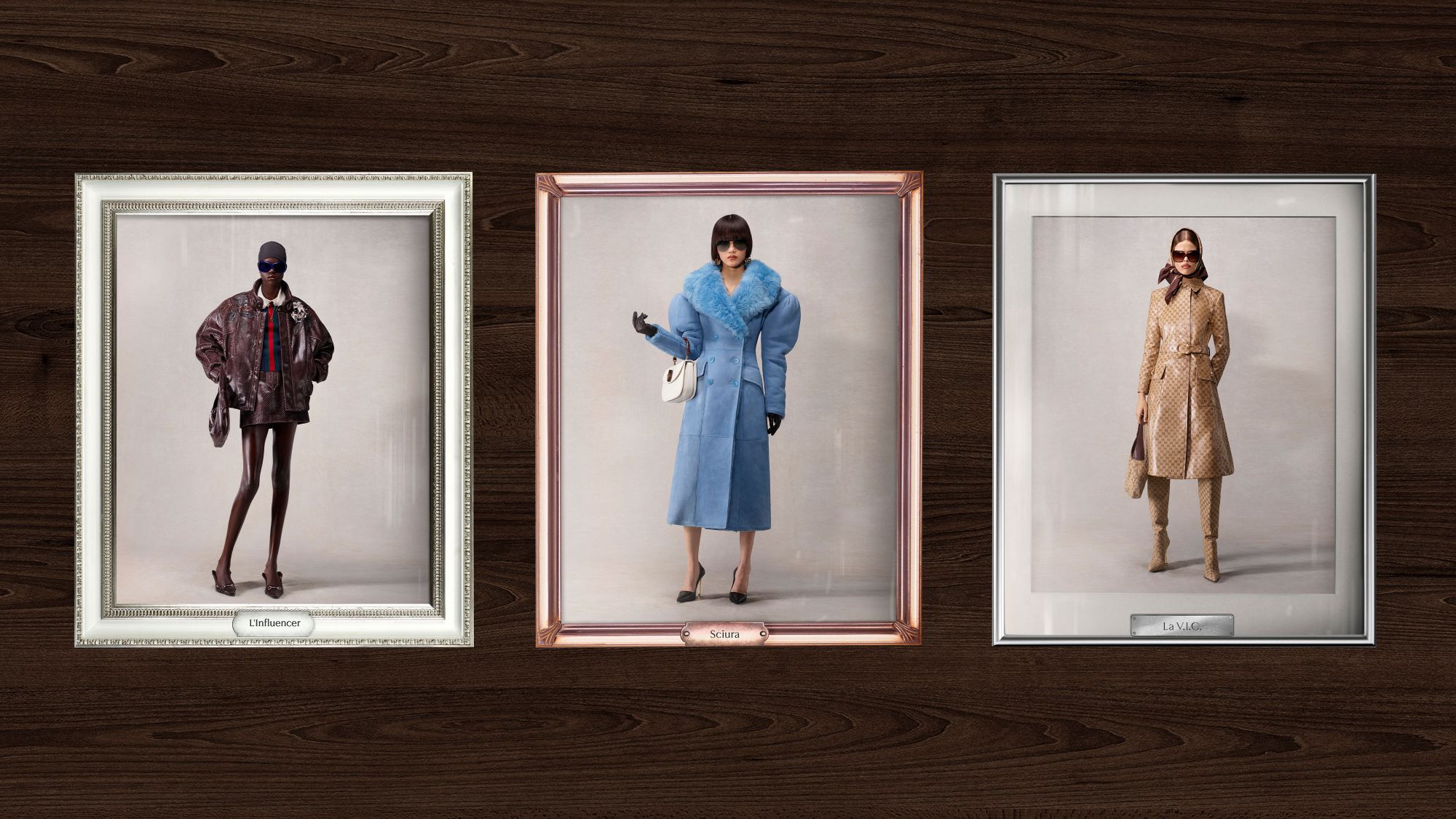
Demna said the quiet part in preview, to WWD, quoted in the same review: "What Gucci means, let's say, to a 60-year-old Italian man is completely different than what it means to a 25-year-old French girl." That is not a statement about creativity. It is a statement about who the customer is allowed to be, and the 25-year-old French girl does not have Bottega money. She is what the industry calls, with light condescension, an aspirational shopper — and Reuters describes the Drip strategy in exactly those terms: "innovative products while keeping costs under control to attract so-called aspirational shoppers."
Here is why the timing matters, and why Milan was the wrong city to read this from.
Gucci's sales have halved over the past three years (Reuters, September 24). Kering's new chief executive, Luca de Meo, took over last year to run a turnaround, and the early share-price bounce has gone flat. And — this is the load-bearing fact — two Kering sources told Reuters the brand "has also begun cutting prices on a select number of products, including in China, as part of efforts to regain market share."
The Chinese-market press had this story weeks before the sneaker made it visible. Jing Daily reported Gucci lowering prices in China on September 8, framing it as cautious consumers questioning luxury value, waiting for further reductions, and favoring gold instead. On September 22 the same publication carried Bernstein's read of the third quarter: a K-shaped luxury market, in which — their framing — houses must choose between cutting prices, as Gucci has, or chasing the wealthiest clients further, as Hermès is doing. We should be straight about sourcing: both Jing Daily pieces are paywalled past their standfirsts from this desk, so we are quoting the publication's own framing lines, not the analysis under them. The framing is enough for the shape of the thing. The shape is a fork, and Gucci took the downhill tine.
So put the week back together in order. September 8: prices quietly come down in China. September 24: the first Demna sneaker arrives, made in China, cost structure to match. September 27: the collection is unveiled inside a literal store. Read from Shanghai rather than Milan, that is not a design debut with some commercial footnotes. That is a repricing program with a runway attached.
The analysts quoted on the sneaker are worth hearing precisely, because they are describing a machine most coverage treats as scenery.
Berenberg's analysts wrote: "We think this creates a potential tension between provenance and the luxury positioning Gucci is seeking to reclaim." Luxury consultant Simon Whitehouse was blunter: "Made in China is not a good look." And Carole Madjo at Barclays relayed the question that actually matters: "Some people are wondering: should we keep buying Gucci if the price is coming down?" (all to Reuters, September 24).
Sit with Madjo's shoppers for a second, because they understand luxury pricing better than most people who write about it. A luxury price is not a cost plus a margin. It is a promise about direction — the bag will cost more next year, so buying it now is almost prudent, and everyone who already owns one is quietly richer each time the price rises. The whole apparatus of provenance, the Made in Italy, the artisan film, the heritage appointment, exists to make that direction feel like a law of nature rather than a decision. Which means a visible price cut is not a discount. It is a default. The shoppers asking whether to keep buying Gucci as the price falls are not being irrational; they are marking their position to market.
Our reading of the week, and it is a reading: the debut era being reviewed as Demna's creative vision is, seen from the market it most needs to win back, a controlled demolition of Gucci's price architecture — done with real skill, and dressed extremely well. The store-as-show is honest set design for it. The archetypes are price points with characterization. And provenance went first because provenance was never the product; it was the justification for the number on the tag, and the number is being renegotiated. If you think that gives the clothes too little credit, Fury's review is genuinely admiring and we don't doubt the tailoring — but nobody builds the shop into the show by accident.
What we can't tell you yet is whether it works. Bernstein's fork says somebody has to serve the customers Hermès is abandoning, and Gucci volunteering for that is a coherent strategy rather than a fall from grace. It is also the strategy with the failure mode Madjo's shoppers already voiced. Both things will be visible in the China numbers within a few quarters, and one of them will be wrong.
The dream, as Fury says, is what's being sold. The renegotiation is happening somewhere much smaller — on a woven tab the size of a thumb, stitched inside an €800 shoe, where the two most expensive words in fashion used to be.